









In this article
Quick answer: Before buying a vintage Cartier watch, check dial printing and Roman numeral alignment, case edges for over polishing, and crown and hands for swapped parts. Ask for close ups of the crown, side profile, and caseback, then confirm service details in writing. In our shop, most pricing surprises come from dial work or heavy polishing, not the model name.
Vintage Cartier has a way of pulling you in fast. The lines are clean. The proportions sit right on the wrist. And the brand carries weight without trying too hard.
We also see the downside every week at the counter. A vintage Cartier watch is one of the easiest categories to overpay for, because the details that change value are usually small.
A dial that was refinished. A case polished too much. A crown swapped during service. A bracelet stretched just enough to feel wrong. None of that jumps out in one listing photo. All of it changes what the watch is worth and how it wears.
This is our ultimate guide and everything you need to know before you buy. Consider it a guide to vintage Cartier watches built from what we actually check in store.
If you want to browse inventory first, start with our collection of Vintage Cartier watches. If you’re comparing across brands, you can also browse all vintage watches.
Why vintage Cartier is easy to love and easy to overpay for
Cartier sits in a rare lane. It’s a luxury watch you can wear daily. It reads as taste, not flash. That comes from Cartier’s design language, what many collectors call the Cartier lines. You see it across decades, even when the cases and bracelets change.
The rich history matters here. Cartier began in Paris in 1847, and the house grew into a leader in jewelry and watchmaking. That history shows up in the design elements buyers chase now, like the Roman numeral dial, blued hands, and the feel of the case on wrist. These are not random details. They are part of the watch design.
We’ll often have two vintage timepieces on the desk that look almost identical from arm’s length. One is priced far higher for a reason that only shows up up close. Original dial vs refinished dial. Sharp case lines vs rounded edges from heavy polishing. Correct crown vs a replacement that fits, but is not right for the watch.
If you want the bigger framework for why two similar watches can land at very different price points, read what changes vintage watch pricing. That applies across luxury watch brands, whether someone is cross shopping a vintage Rolex or even a Patek Philippe.
The 60 second Cartier check (the quick scan in store)
If you only remember one thing from this guide, make it this. Do a quick scan before you fall in love.
This is the same order we use when someone hands us a Cartier timepiece at the counter, whether it’s a new watch purchase being evaluated or a true vintage wristwatch.
Dial printing and signature details (what “off” looks like)
The dial is where the most expensive mistakes start.
What we look for first:
- Printing that looks crisp and consistent. Cartier text and minute markers should look clean, not fuzzy or heavy.
- Roman numeral spacing that feels deliberate. On many Cartier dials, the Roman numeral layout is part of the signature, so spacing and alignment matter.
- “Swiss” or “Swiss Made” placement that matches the dial layout. Placement varies by era and model, but it should not look forced.
- Aging that makes sense. Light patina can be normal. Harsh blotches, uneven tone, or a dial that looks brand new while the case looks worn can point to refinish work.
If you want a broader inspection framework that works for any brand, keep our buyer’s checklist for condition and originality open while you shop.
Case lines and polishing (how value gets erased)
Case condition is where value quietly disappears.
Cartier cases are all about geometry. Clean lines. Defined edges. Smooth transitions. Polishing can soften those lines over time. Light polishing is common. Heavy polishing changes the shape.
You’ll see different shapes across the collection. Some models lean rectangular, some lean round case, and some are built around a square case. What matters is whether the case still holds its original profile.
What we check:
- Edges that should be sharp still look defined
- Symmetry from left to right
- Brushing looks even where it belongs
- Corners do not look rounded around the bezel or lugs
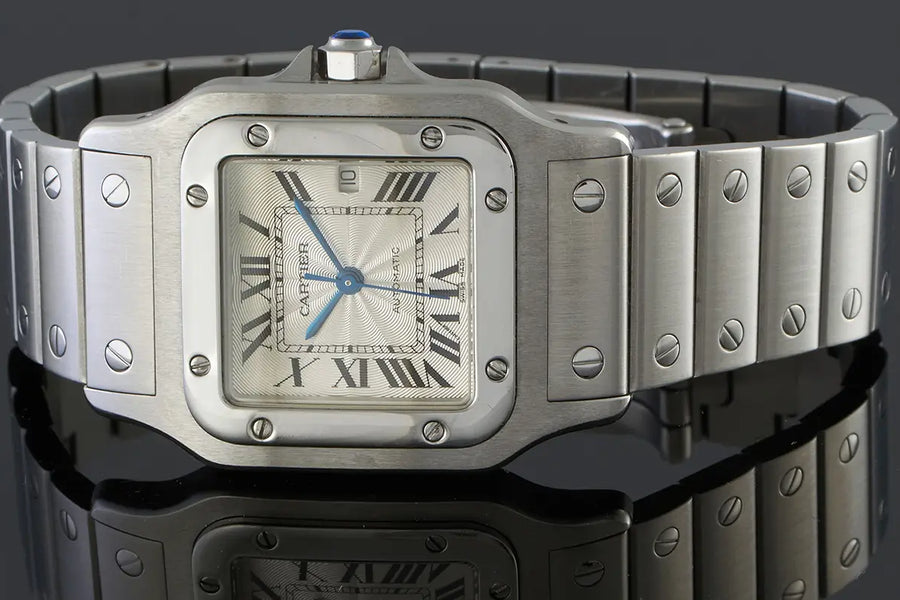
For a Cartier Tank, the rectangular case should still look intentional. For a Santos, the case and bezel lines should still look strong. If the watch was described as having a featured a square case, it should still read that way on wrist.
Crown, hands, and crystal (common swap points)
Small parts get swapped for practical reasons. A watch breaks. A service happens. Parts get replaced.
Replacement is not automatically bad. The question is whether the replacement changes value and correctness.
What we look at:
- Crown shape and size. Cartier crowns have specific profiles by model.
- Cabochon crown details. Many Cartier crowns include a blue cabochon, so fit and finish should look right for the watch, not generic.
- Hands. Hands should match the dial layout and the period. Mismatched hands are a common tell of replacement.
- Crystal fit. A new crystal is normal. Poor fit, odd distortion, or gaps can be a red flag.
- If you’re shopping online, ask for clear photos of the crown, dial text, side profile, and caseback. Those angles tell you more than a perfect front photo.
Serial numbers, hallmarks, and paperwork (what matters, what doesn’t)
People love paperwork because it feels like certainty. In vintage, it helps, but it should not be the deciding factor by itself.
What matters most:
- Serial markings that look clean and consistent with the era
- Caseback engravings that look correct, not sloppy or freshly cut
- Hallmarks on precious metal cases when applicable, especially when the watch is solid gold
- Service notes from a reputable watchmaker when available
- What matters less than people think:
- A box with no clear connection to the watch
- Generic papers that do not match the watch’s details
- A certificate that confirms the brand but not the specifics
- Paperwork can support value, but it does not replace inspection.
If you want documentation for insurance, resale, or estate planning, plan for appraisal paperwork for insurance after purchase. In our store, that’s often the step that gives buyers real peace of mind, because it puts the details in writing.
Service reality (parts, timelines, and what “serviced” should mean)
When a listing says “serviced,” ask one question: serviced how?
A proper service should include more than “it runs.” It should address:
- Movement performance and reliability
- Gaskets and realistic water resistance expectations for vintage
- Correct function of crown, setting, and hands
- Worn parts that affect timekeeping and wearability
If you’re looking at a Cartier with a quartz movement, the service conversation changes. You still care about condition, seals, and correct parts, but battery history and corrosion checks matter too.
Vintage Cartier can be an excellent daily watch, but you want to know what you’re signing up for:
- Some parts are model specific
- Timelines can vary
- The cheapest service path can create the most expensive outcome later
If you’re buying in person, ask what was done and when. If you’re buying online, ask for service details in writing.
Most searched Cartier styles (what to watch for in each)
When people search Cartier, they usually start with a few core watch collections. The Cartier collection is deep, but these models come up constantly, and each has its own tells.
Tank collection
The Tank collection lives and dies on proportion and dial execution. Many Tank models lean rectangular and rely on dial balance. The Roman numeral layout is a big part of the identity, so printing quality matters.
Cartier introduced the Tank line early in the brand’s watch history, and several Tank references have their own quirks. You’ll hear collectors mention Tank Normale, Tank Solo, and Tank Louis Cartier. The tank louis cartier name comes up a lot because it represents the classic look people picture when they say iconic Tank.
What we check:
- Dial printing quality and alignment
- Roman numeral clarity and spacing
- Case edges and shape, especially across a rectangular case
- Crown style that matches the era
- Strap fit and lug width, since some cases are specific
This is an iconic watch category for a reason, but condition still drives value.
Santos de Cartier
Santos de Cartier often shows wear faster because of the bracelet and exposed hardware look. The exposed screws are part of the design, so wear around them and over polishing can stand out.
The Santos story matters too. The watch is tied to aviation history, created in 1904 for the aviation pioneer Alberto Santos-Dumont, a Brazilian aviator Alberto Santos-Dumont who wanted a wristwatch he could read while flying. That origin is why many people still call it a pilot’s watch, even though it wears more like a refined luxury sports watch today.
What we check:
- Bezel edges that still look defined
- Bracelet stretch and fit on wrist
- Screw details that look consistent
- Case lines around the bezel, since some examples feature a square case silhouette
A clean Santos wears extremely well. A heavily worn one can still look good, but price should reflect what you’re seeing.
Panthère watch
The Panthère watch is bracelet driven. Fit and comfort matter as much as the dial. You’ll see it written as Cartier Panthere or Cartier panthere in listings, and sometimes people mention an iconic panther motif when they talk about the design language. In practice, what matters most is bracelet condition and how it sits on the wrist.
Check:
- Bracelet stretch
- Link condition and feel on wrist
- Clasp function and alignment
- Case wear that suggests heavy daily use
Sizing matters here. Many buyers looking for men’s wristwatches want a stronger presence, while others prefer the slimmer profile that works as a daily luxury watch.
Ballon Bleu de Cartier
Ballon Bleu de Cartier is newer than the others, but it’s searched often. Ballon Bleu models are usually evaluated more as wearable luxury timepieces than strict collector pieces.
Check:
- Crown guard shape and symmetry
- Dial printing and Roman numeral balance
- Case finishing
- Service history if it has been worn regularly
Cartier Baignoire
Cartier Baignoire attracts buyers who want something less expected. It’s also a model where proportion and dial condition matter a lot.
Check:
- Dial printing and any signs of refinish work, especially around the Roman numeral track
- Case shape and edge definition, since heavy polishing can change the silhouette
- Bracelet condition if it’s on a bracelet, especially stretch and clasp alignment
- How it sits on wrist, because fit is part of the appeal
Other names you may see in listings
Depending on the era, you may also come across Must de Cartier, Drive de Cartier, Cartier Roadster, and Cartier Pasha. The Cartier Pasha story is often linked to the Pasha of Marrakesh, and some versions are described as created for the Pasha. These are real parts of Cartier’s watchmaking lore, but the buying rules stay the same. Condition, correctness, and service reality come first.
Serial language you may see: “de Cartier”
You’ll often see model names written with “de Cartier,” like Santos de Cartier or Ballon Bleu de Cartier. The phrasing is common in listings and marketing, but it does not replace real verification. Focus on the physical watch, the condition, and the details that match the era.
Buying in NYC vs online (risk, verification, and returns)
Online gives you selection. NYC gives you control.
When you buy in person, you can:
- Check dial printing with your own eyes
- Inspect case lines from multiple angles
- Feel bracelet stretch and comfort
- Confirm how the watch sets and winds
- Online can work, but you need discipline:
- Ask for specific photos: dial text, crown, side profile, caseback
- Ask direct questions about service history and parts
- Confirm the return policy before you pay
- Assume lighting can hide issues, because it can
When you’re comparing watch collections online, it helps to narrow the Cartier collection down to one model family first, then judge condition within that lane. That simple step prevents a lot of bad comparisons in the world of vintage.
If you want two guides that help you shop smarter, start here: buyer’s checklist for condition and originality and what changes vintage watch pricing.
If you want help choosing the right one
Cartier watches offer a wide range of looks, sizes, and eras, and Cartier remains one of the most wearable names in vintage. If you have a specific reference in mind, we can help you narrow it down based on wrist size, budget, and the details that matter most for value. If you’re hunting a particular piece, you can source a specific Cartier reference and we’ll help you find the right fit.
Quick FAQ
How do I know if a Cartier dial was refinished?
Start with printing. Look for text that feels too thick, uneven, or slightly blurry. Then compare dial wear to case wear. If the dial looks new but the case looks aged, ask why. Request close ups in neutral lighting.
Do box and papers matter for vintage Cartier?
They can help, but the watch matters more. Papers carry the most weight when they clearly match the watch details or support provenance. A box by itself does not prove much.
Is polishing always bad?
No. Light polishing is common. Heavy polishing can soften edges and change the original case shape, which can affect value. You want a case that still holds its lines.
Should I only buy vintage Cartier if it has service records?
Service records are a plus, especially if you plan to wear it often. If there are no records, factor in the cost of a proper service and buy from a seller you trust.
What should I ask a seller before buying?
Ask for clear photos of the dial, crown, side profile, and caseback. Ask what was serviced, when it was serviced, and whether parts were replaced. Then compare what you see to known correct examples.