








In this article
Clients often come into our Fifth Avenue showroom asking the same question: asking the same question: what’s the difference between antique and vintage watches, and does it matter before you buy.
It matters more than most buyers realize. The age of the watch may affect reliability, servicing, parts availability, and the watch’s value. If you are starting to look at watches made in different eras, the labels can feel inconsistent because the term is used in the watch market in different ways.
This guide helps you decide whether a pre-owned watch could be vintage, could be vintage or antique, or is clearly classified as one or the other. We also cover what changes with old watches and what to look for before you commit.
Quick Answer: Antique vs Vintage Watches
If you want the short answer before diving in:
- Antique watches are generally 100 years old or more and are best suited for collecting and occasional wear.
- Vintage watches are typically 20 to 90 years old and are usually easier to service, more reliable, and better for regular wear.
- If you want a watch you can wear often, vintage is usually the safer choice.
- If you want historical significance and rarity, antique may make sense, but with higher maintenance expectations.
Most buyers who come in looking to buy antique watches ultimately choose vintage once they understand the differences.
Scroll below for a deeper breakdown of what actually matters before you buy.
Antique vs Vintage Watches, the Clean Definition Buyers Should Use
Here is the clean definition we use at the counter.
An antique watch is generally classified as antique when it is at least 100 years old. In other words, it is least 100 years old before it is properly classified as antique.
Vintage is used to describe watches that are older, but not antique. Across the vintage watch market, the market to classify pre-owned watches is more flexible. Many sellers use vintage to classify pre-owned watches older than 20 years, especially in the pre-owned watch market where the term is used in the watch market as shorthand for older production.
That is why you will sometimes see a watch described as vintage or antique but usually it is neither in the strict sense. You will also see antique but usually refers to true antique age, even if the seller is casual with language.
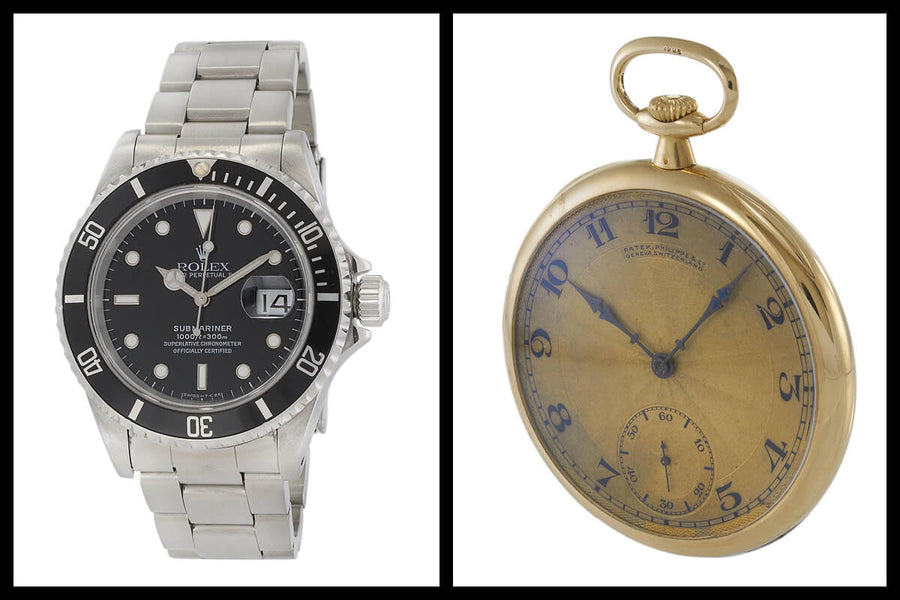
Examples of antique watches often include pieces from the late 1800s through the early 1920s, including some of the finest pocket watches from major makers. Many watches from the late 19th century fall into this category. An example of this, is the Antique 1920s Patek Philippe & Co. Pocket Watch.
Vintage watches often start later, and you will see watches produced throughout the 1920s, 1930s, 1940s, and into the decades after. Even watches from the mid century period are often classified as vintage or antique incorrectly online, which is why the semantics of old watches matters. Examples of highly recognized vintage watches are the vintage Rolex Submariner and the vintage Omega Speedmaster.
If you want a practical path that works for most buyers, treat “antique” as 100 years old or older, and treat “vintage” as older pre-owned watches with strong wearability.
How buyers date a watch accurately
One of the most common questions that vintage watch dealers are asked is simple: ‘when was my watch made?’
To usually date a watch accurately, we start with the serial number on the watch. That might be the serial number of your watch on the movement, the reference on the case, or sometimes a relevant watch case serial number depending on the brand.
Online to date a watch, many people use brand charts or forum archives, and that can be helpful. But to date any watch originally certified as authentic, you often need more than photos. Dating a watch from photos can work for some watches like common references, but the best answer usually comes from verifying markings in person.
In some cases, we need to open your watch. That is because the serial number on the watch is often inside, and you may need to open your watch and look at the movement to confirm age, originality, and what has been replaced. If you want us to date any watch, we treat it like a watch and look at it the way a watch specialist would, not like a guess based on one photo.
What Changes as a Watch Becomes Vintage or Antique
As a watch becomes vintage, the goal is usually wearability with character. As a watch becomes antique, the goal often shifts toward collecting, history, and condition preservation.
With older watches, you will notice differences in:
- Parts availability, because a watch may be difficult to service if components are scarce
- Servicing standards, because not every watchmaker handles antique movements
- Case design and durability, because the watch case may show wear that impacts function and value
- Practical use, because many antique era pieces were not built for modern daily wear
This is where vintage watch dealers earn their keep. A trusted vintage watch dealer explains what was replaced, what is period correct, and what matters for ownership.
If you are comparing brands, you will often see people debating whether a fine vintage Omega or Rolex is the better first choice. The truth is both can be great, and a perfectly fine vintage Omega can be a smarter buy than something flashier with questionable history.
How to spot common issues in antique and vintage watches
Condition is not one thing. It is a stack of details. Old watches can look great in one photo and still have issues that change value quickly.
Here is what we check, and what you should check too.
Watch case condition
The watch case tells a story. Over polishing can soften lines and reduce collector demand. Damage to lugs, dents, and poorly fitted parts matter. If a watch has a solid gold case, case condition becomes even more important because soft metal can wear down over decades.
Dial and hands
Dial originality matters. Hands that do not match the era or dial style can signal past swaps. Some restoration is normal, but a seller should disclose it clearly.
Function and movement health
A watch may run, but still have problems. Ask how it winds, sets, and whether the timekeeping is stable. If the watch is classified for sale as “recently serviced,” ask who serviced it and what was done.
Provenance and disclosure
If someone previously owned the watch and kept documentation, that helps. But watch or its provenance is not always documented, and that is common. What matters most is clear disclosure from the seller.
When to Choose Antique vs Vintage Watches Before You Buy
Antique watches make sense when you want history and rarity, and you accept that servicing can be specialized. Vintage is usually the safer buy when you want reliability and regular wear.
Antique may be right if:
- You are building a historical collection
- You enjoy provenance and research
- You plan occasional wear
Vintage may be right if:
- You want a daily wear watch
- You want easier servicing and stronger resale demand
- You are buying a gift meant to be worn
This difference between antique and vintage matters because ownership costs are real, and the effect on how a watch wears over time can be significant.
Best Use Cases for Vintage and Antique Watches
Collecting
Antiques can be special, especially early pieces with true heritage. Vintage collecting is often easier because there are more reference examples and more service support.
Gifting
Vintage tends to be the better gift choice. With antiques, the recipient needs the right mindset.
Daily wear
Vintage is usually the answer. Mechanical watches still need maintenance, but the ownership experience is simpler.
If you are visiting a vintage watch store NYC shoppers trust, you will usually see far more vintage than antique because wearability matters.
Many travelers looking for vintage watches in New York want a piece they can actually wear, not just store.
A Simple Buying Guide and Checklist for Antique and Vintage Watches
If you are buying antique watches:
- Confirm it is classified as antique, not just described that way
- Ask whether the movement has original parts
- Assume servicing may be specialized
- Expect that a watch may be difficult to wear daily depending on condition
If you want to buy a pre-owned watch that you will wear often:
- Verify dial, hands, crown, and case details
- Ask for service history and timing notes
- Check the watch case condition carefully
- Buy from a seller who discloses clearly, ideally a trusted vintage watch dealer
If you are ready to compare options, start with our curated selection of buy antique watches and then narrow by brand, size, and style.
Common questions vintage watch dealers hear in NYC
These are questions that vintage watch dealers hear every day, and they are worth asking.
What should I ask first
Ask what is original, what has been replaced, and whether service history is documented.
Can you date it
Ask about the serial number of your watch and whether the seller verified it. If the seller only says “it looks vintage,” ask what they used to verify.
Does brand matter
Yes. Watch brands with strong archives and common references are easier to verify and service.
Quick FAQ
What’s the difference
The simplest answer is age and use. Antique is generally 100 years or older. Vintage is older pre-owned, usually later than antique, with more wearability.
When was my watch made?
Start with the serial number on the watch. In many cases, you need to open your watch and look at the movement to confirm.
What if the listing doesn’t have a relevant watch case serial number
Then you are relying on weaker evidence. Ask for movement serials, reference details, and additional photos, or slow down.
Is a pre-owned watch acceptable as vintage
Yes. A pre-owned watch could be vintage depending on age and the way the market to classify pre-owned watches older than 20 years is being used by the seller.
How should I think about value
A watch is worth whatever someone is willing to pay, but watches hold value better when condition, originality, and disclosure are strong.
Final Thoughts
The origin of the word vintage comes from wine, but in watches, it is a market term. It is used to describe watches that are older and desirable, and the pre-owned watch market does not always agree on exact cutoffs. Generally agreed across the vintage community, the best way to buy is to focus less on the label and more on the details.
If you have a love for vintage watches, the safest move is simple: choose the piece that fits your life and your budget, and buy from someone who discloses clearly.
If you are ready to shop, start with our vintage rolex selection, which is also where many visitors looking for a vintage watch store NYC begin.